We are his workmanship, created in Christ Jesus unto good works, which God hath before ordained that we should walk in them. — Ephesians 2:10
We are not an accident. We are not merely users of tools. We are not a collection of reactions, data, tasks and fears. We are a work. And a work does not come into being in haste. A work needs silence, a hand, material, time and responsibility.
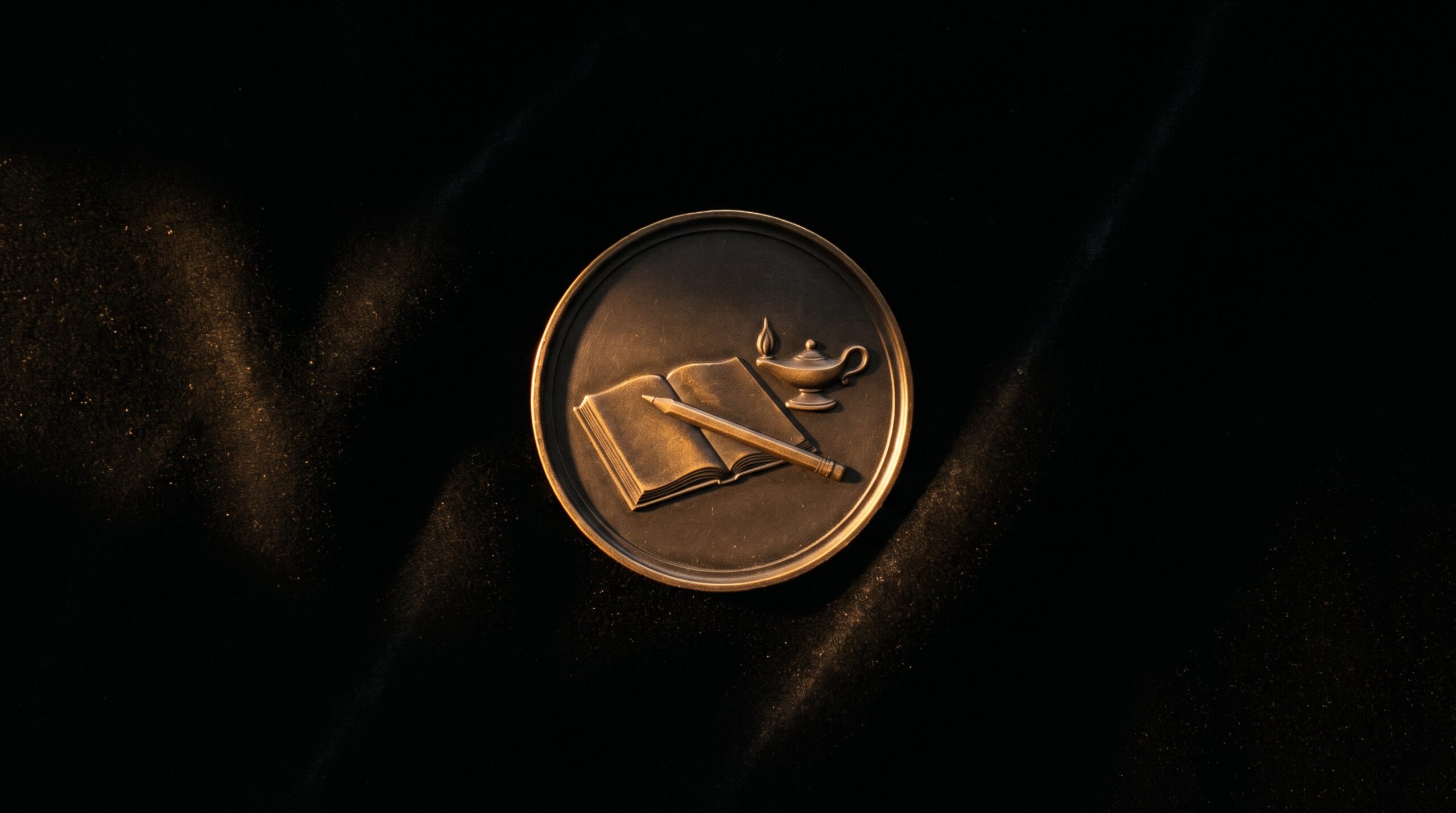
That is why, this Sunday, it is worth returning to simple things. To a sheet of paper. To a pencil. To a book. Not against artificial intelligence. Not against technology. Not against the future. But so that the human being does not lose himself in a world that answers ever faster, before we have had time truly to ask.
There are moments when a person does not need yet another tool. He needs a table. Silence. A sheet of paper. A pencil. A book that is in no hurry alongside him. He needs a moment in which no one is measuring him, prompting him, correcting him, shortening his thought or turning it at once into a message.
For today a great many people are not merely tired of work. They are tired of the pace of answers. Tired of the fact that every question must have a result immediately. Tired of the expectation that every thought should be instantly useful, publishable, optimal, ready to be shown to the world.
In the age of artificial intelligence, a person may begin to believe that the value of a thought is measured by the speed at which it is generated. And yet the most important thoughts in life rarely come quickly. Sometimes they come after a long silence. Sometimes after a failed sentence. Sometimes after a mistake. Sometimes after a conversation that hurt. Sometimes after reading a single page that one must return to three times. Sometimes after a person finally takes up a pencil and writes a sentence that no one but he wishes to see: I do not know.
It is one of the most honest sentences a person can write. And one of the most needed. For true discernment begins with “I do not know”. Not with the appearance of certainty. Not with an automatic answer. Not with someone else’s language. With the modest admission that one must return to the source.
Paper restores a person to himself
Paper is not nostalgic. Paper is honest. It does not glow. It does not send notifications. It does not suggest the next sentence. It knows no trends. It does not know what will have better reach. It does not try to hold our attention for longer. Paper waits. And in that waiting there is something profoundly human.
On paper the truth of thinking becomes visible. One can see where we begin boldly and then retreat. One can see which word is ours and which we have borrowed from the language of the world. One can see the chaos. One can see the shortcut. One can see the crossed-out sentence. One can see the trace of hesitation.
And this matters, because a person does not mature without leaving a trace. A digital text can be corrected as if there had never been an error. A sheet of paper reminds us that thinking had a path. That we were working our way towards something. That we tried. That not everything was clear at once.
In the doctrine of Just Council this is very important. The point is not that a person should always be right immediately. The point is that he should have the courage to walk the path of truth. And truth sometimes begins with a mess on a sheet of paper.
The pencil teaches mercy towards one’s own thinking
The pencil is an instrument of humility. It does not pretend to finality. It does not shout that everything has already been settled. It allows us to go back. It allows us to correct. It allows us to strike something out without humiliation.
In this sense the pencil is very close to a culture of justice. For Just Culture does not say to a person, “you are your mistake”. It says: let us see what happened, what we can learn, and how to restore responsibility without destroying the person. The pencil works in a similar way. It does not remove responsibility. But it offers the possibility of correction.
In the digital age we often wish to appear as though we think without effort. As though every thought were born complete. As though every sentence were clean from the outset. As though there were no fear, no hesitation, no correction, no contrition. But a human being is not a machine for producing flawless messages. A human being is a work in progress. A work that matures. A work that can be mistaken. A work that can turn back. A work that is called to good works — but does not always know at once how to name them.
That is why we need the pencil. Not only for writing. For the exercise of the heart.
The book reminds us that we are not the world’s first generation
Artificial intelligence can summarise a book. But it cannot live through the encounter with a book on our behalf. The difference is enormous. A summary gives information. Reading gives formation.
When we read a book, we enter someone else’s time. Someone else’s patience. Someone else’s path. A sentence that was not written in order to serve us instantly. A good book offers resistance. It does not always wish to yield. Sometimes it requires a person to grow up to its meaning.
And perhaps that is precisely why the book is so needed today. For the digital world has accustomed us to expecting everything to be available instantly. Yet wisdom is not instant. Wisdom requires time. Faithfulness. Return. The capacity to read something that is not written in our language, at our pace, out of our fear or in our interest.
The book reminds us that there were people before us. That they suffered. That they built. That they went astray. That they loved. That they waged wars, created states, rescued children, lost hope and regained it anew. The book restores proportion. And a person without a sense of proportion very easily hands over his conscience to the loudest tool.
Artificial intelligence is not the enemy. The enemy is the homelessness of the human being
The point is not to turn away from artificial intelligence. That would be too simple and dishonest. It can help. It can organise data. It can support analysis. It can speed up work. It can serve medicine, education, security, public administration, science and organisations.
But it must not become a place to which a person flees from his own discernment. It cannot replace conscience. It cannot replace contrition. It cannot replace responsibility. It cannot replace conversation with another human being. It cannot replace silence. It cannot replace the book. It cannot replace the hand that writes the first, clumsy sentence.
The greatest risk of the age of artificial intelligence is not that the machine will become too like the human being. The greatest risk is that the human being will become too like the machine. That he will be fast but shallow. Visible but empty. Effective but absent. Eloquent but not himself. Active but without a path.
And yet the text does not say that we were created to produce content. It does not say that we were created to optimise our presence. It says that we were created for good works. And that we are to walk in them. Not scroll through them. Not simulate them. Walk.
A Sunday practice: three questions on a sheet of paper
Perhaps today it is worth doing something very simple. Not a grand plan. Not an app. Not a productivity system. One sheet of paper. One pencil. One book.
At the top of the sheet, write: what good has been entrusted to me for this week? Not: what must I deliver. Not: what must I publish. Not: to whom must I prove something. Only: what good has been entrusted to me?
Then three questions:
- For whom, or for what, am I truly responsible?
- Whom can my decision protect?
- Which path should I take, even if it is not the easiest?
And only afterwards open the computer. Only afterwards ask the tool. For if a person does not first return to himself, technology will very quickly suggest to him a version of himself that is efficient, attractive — and someone else’s.
Returning to the human being is not an escape from the future
Just Council is not a doctrine of fear of the future. It is a doctrine of passing responsibly through the future. The point is not to defend the old world merely because it is old. The point is not to surrender the human being without a struggle to a world that knows how to measure him, classify him, predict him and stimulate him — but does not know how to love him.
Paper, pencil and book are a small shield today. The shield of paper protects thought from distraction. The shield of the pencil protects the process from the pride of flawlessness. The shield of the book protects memory from the tyranny of the present.
These are simple things. But civilisations often fail not when they lack technology. They fail when they lose the capacity to form the human being. And a human being is not formed by a screen alone. A human being is formed by presence, by the word, by example, by reading, by responsibility, by silence and by the work of the hands.
The defence of people — the Shield of Poland
If we are to speak of the Shield of Poland, we cannot reduce it solely to equipment, infrastructure, procedures and security systems. All of these are necessary. The state must be resilient. Hospitals must have cybersecurity. Schools must have child protection. Public administration must have the capacity to act. Borders must be secure. Data must be protected. Energy, water, health, transport and communications must be resilient.
But the deepest Shield of Poland begins earlier. It begins in the human being. In his ability to distinguish truth from noise. In his ability not to give in to panic. In his ability to read, to think and to converse. In his capacity for responsibility. In his ability to say “prove it”. In his ability to pause before reacting. In his ability to protect the weaker. In his capacity for a good that does not pay off immediately.
For a state is not defended by institutions alone. A state is defended by people who have not surrendered their inner selves to chaos.
The shield of conscience
The first line of defence is a person who knows that not everything that is possible is good. Technology may suggest a solution. The market may suggest a profit. Politics may suggest convenience. The crowd may suggest anger. But conscience asks differently: is this just? Does this protect the human being? Does it not destroy the weaker? Does it not humiliate the one who made a mistake? Does it lead to peace, or merely to victory over another? Without the shield of conscience, technology becomes a weapon without direction.
The shield of family and community
The second line of defence is small communities. The family. Friends. School. The workplace. The neighbourhood. The community of faith. A lonely person is easier to break. A person cut off from conversation is easier to manipulate. A person who has nowhere to return to more often gives himself over to whatever is loudest. That is why the defence of people begins with the rebuilding of bonds. With a phone call to someone close. With the table. With a conversation without a screen. With the question: how are you, really?
The shield of the book and of education
The third line of defence is the capacity to think. A nation that stops reading begins to live by other people’s shortcuts. A nation that stops writing loses its own language. A nation that loses its language loses the capacity to defend its freedom. That is why the book is part of the state’s resilience. The library is part of security. The school is part of national defence in the deepest sense — not because it is to militarise children, but because it is to form people capable of truth, responsibility and service.
The shield of organisations and Just Culture
The fourth line of defence is organisations that do not destroy people for their mistakes. A hospital, a public office, a company, a school, a university, a bank, a public institution — each of these places can either build resilience or weaken it. If an organisation punishes every mistake, people begin to hide the truth. If an organisation does not hold people to account, people lose trust. If an organisation does not learn from its failures, it will repeat them. Just Culture is therefore an element of the Shield of Poland. For a resilient state is not a state without mistakes. It is a state that is able to see a mistake, understand it, repair it and learn from it without humiliating the human being.
The shield of the state and of infrastructure
Only the fifth circle is the state in the technical sense: infrastructure, cybersecurity, civil defence, public health, communications, energy, data, transport, borders and crisis response capability. This circle is necessary. But it is not enough. For even the best infrastructure will not defend a society that has lost its trust, its language, its memory and its capacity for cooperation.
The Shield of Poland must therefore be at once material and moral. Technical and human. Digital and spiritual. Of the state and of the home. Strategic and everyday.
Conclusion: the human being first
In the world of artificial intelligence it is easy to mistake acceleration for development. Easy to mistake access to information for knowledge. Easy to mistake a fluent answer for wisdom. Easy to mistake visibility for presence.
That is why we need a simple return. To paper, which makes us pause. To the pencil, which allows us to correct. To the book, which teaches patience. To Sunday, which reminds us that a human being is not merely a function of work. To community, which protects against loneliness. To conscience, which asks about the good. To a state that is to defend people, not merely systems.
For we are a work. Not a profile. Not a prompt. Not a result. Not a resource. Not a machine of reactions. We are a work — created for good works. And good works do not happen by themselves. We must walk in them.