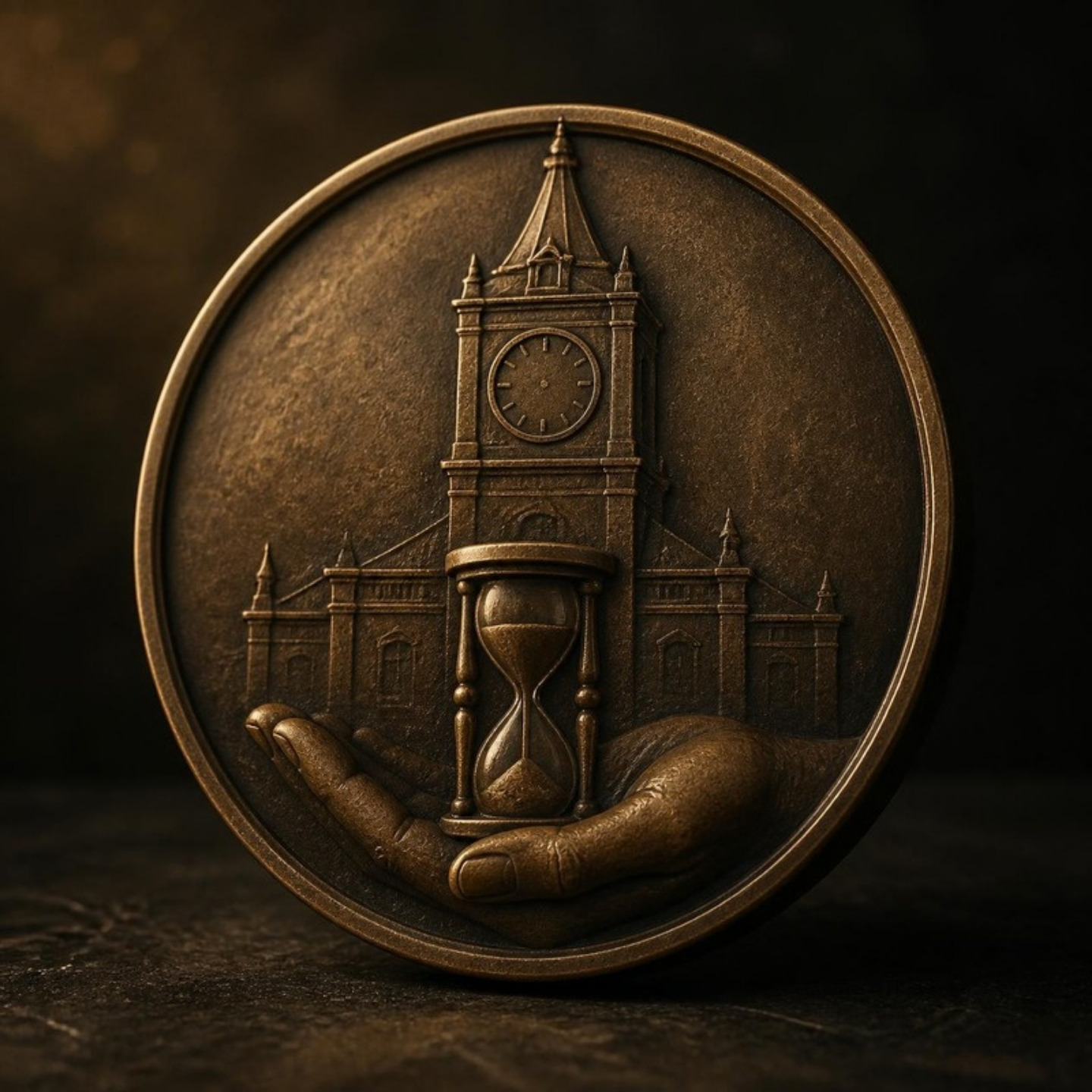
“Hope deferred maketh the heart sick: but when the desire cometh, it is a tree of life.”
Prolonged waiting brings pain to the heart, but a wish fulfilled is a tree of life.
Prov 13:12
The Parable
There was once a city that had two clocks.
The first hung on the town-hall tower and measured out the treasury’s year: from account to account, from one closing of the books to the next. Everyone could see it and everyone knew how to read it. The second clock hung nowhere. Every sick person carried it within, and only they could hear its ticking. The first clock could be reset by a resolution of the council. The second no one ever reset.
One day a woman from the valley came to the city infirmary. The physician examined her carefully and said: “You need medicine, and you should not have to wait long for it.” So he went to the steward who guarded the chest of medicines.
The steward opened the chest and showed that it would stand empty until the end of the year. That year more sick people had come than had been foreseen. The council had brought in new medicines, better and dearer than the old ones, which physicians and patients had been asking for for years. Sick people had also come from neighbouring towns, for the infirmary was famed for healing well.
The steward was not miserly, but he was not permitted to give out what he did not have. The council was not cruel, for it was the council that had brought in the new medicines. The sick from neighbouring towns were not at fault for having trusted. Each had acted rightly by his own measure.
So the steward said to the woman: “Come back after the new year.” And she asked only: “Will my illness wait?” No one knew how to answer her.
Then voices were raised in the city. Some cried that the physician was to blame, for he had promised what he could not give. Others, that the steward was, for he had shut the chest. Others still, that the council was, for it had reckoned badly. For three days the city searched for the guilty one, and for those same three days the woman waited.
On the fourth day the Council of the Righteous assembled. The eldest among them said: “You have been looking for a person, when you should have been looking for the place where it broke. Each of you acted rightly by your own measure, and yet this woman waits. If the people were upright and the outcome is bad, then it is the measure that is bad, not the people.”
First they asked the physician: “Why did you tell her the truth? You could have delayed until she went away of her own accord, and the city would have had no trouble.” The physician replied: “Because a person who does not know what he is waiting for suffers twice: once from the illness, and a second time from not knowing.” The Council resolved that this man would not be punished, but heard. “If you punish the one who told the truth, the next one will stay silent. And silence has never yet healed anyone.”
Then they asked the steward: “Why did you not give out beyond the measure?” “Because the law forbids me,” he answered. “Rightly so,” said the Council. “The city’s account must balance. But from now on the chest shall have a separate compartment that may not be closed to the sick once their treatment has begun. When that compartment runs empty, the council shall refill it of its own accord, without waiting for the outcry of the street. The account will balance, but not at the expense of the time of the sick.”
Last of all they asked the city’s councillors: “How did it come about that you did not know?” “We counted by the average,” they replied, “and on average the city was doing well.” The Council said: “From today, count the one who has waited longest, for he is the measure of the city. And let every number have someone who answers for it, for a number without an owner is merely a description of suffering.”
Meanwhile the townspeople began collecting money for the woman from the valley, and it was a good deed. Yet the eldest of the Council reminded them that their fathers, impoverished after the wars, had once pooled their money penny by penny for a house in which everyone was healed, including those whom the donors were never to meet. “That generosity built the city. Today’s must patch it. Let us arrange things so that your generosity may build once more.”
The woman from the valley received her medicine in time. Not because someone was punished, but because someone changed the measure. And the clock on the town-hall tower was reset so that it kept time with the other one, the one no one hears. From then on, whenever someone in the city was waiting, the first question asked was not who was to blame, but what had to be repaired, and who would see to it that the same fire did not break out twice.
An Exposition of the Parable
On the measure, not on people. The city’s first reflex was to look for someone to blame, and it is an understandable reflex, for a wrong demands a wrongdoer. The doctrine of Just Council, however, requires that the mechanism be described first and judgement passed only afterwards. When all participants act lawfully and in good faith and the outcome is nonetheless harmful, justice does not consist in pointing to a scapegoat. It consists in repairing the structure. To judge a person in place of judging a mechanism is a twofold error: it wrongs the innocent and leaves the cause untouched.
On a truth that must not be punished. The physician in the parable acts according to the principle that lies at the heart of Just Culture: it distinguishes honest error, at-risk behaviour, negligence and deliberate action, and each of these calls for a different response. Whoever reports a shortage is not its cause, but merely the first to have noticed it. Punishing the truth teaches silence. The most dangerous community is not one in which people make mistakes, but one in which they have learnt to hide them. Compassion with discernment does not abolish responsibility. It does, however, protect the one who responsibly speaks the truth.
On the proportion of risk. The treasury can bear risk: it has reserves, forecasts and the right to make corrections. The sick cannot, for the progression of an illness cannot be paid in instalments. A structure that shifts the burden from the one who can carry it onto the one who cannot is disproportionate, even if each of its elements is lawful. The Council does not call into question the principle that the account must balance. It adds to it a second, equally firm: not at the expense of the time of the sick.
On the measure of the weakest. The average describes the city at rest, while the tail of the distribution describes it under strain. A community that counts itself by the average does not see those it serves worst. That is why the dignity of the person who has waited longest becomes the measure of the whole, rather than an exception to it.
On the loop that closes. A single intervention treats the symptom, whereas a change of measure treats the cause. A resilient community is not one that puts out fires efficiently, but one in which the same fire does not break out twice: measurement, explanation, decision, implementation and accountability form a single learning loop.
On generosity that builds. The parable draws on historical experience, not on legend. In 1925 the foundation stone was laid in Warsaw for the Radium Institute, built largely from the donations of Poles, in a young state emerging from wars and the partitions. Solidarity was then transformed into an institution, and the institution into trust. Every fundraising appeal for medical treatment today is an act of goodness and is not subject to judgement. Their sum, however, is information about where the community is taking on a task that ought to belong to its institutions.
On hope. The verse from the Book of Proverbs has two halves. The first speaks of a heart wounded by waiting, the second of a tree of life. Hope here is not a mood sustained in defiance of reality. It is a promise whose fulfilment someone must organise. The parable therefore ends not with a verdict but with a change of measure, for a text without a way forward would be merely a description of pain.
What this parable does not claim. It does not claim that physicians, stewards or councillors are bad. On the contrary, it shows upright people within an imperfect structure. Nor does it claim that a simple remedy exists. It claims only that the question “who is to blame?” must be replaced by the question “what must be repaired, and who is responsible for it?”, and that every community capable of withstanding a trial begins with this substitution.
The account must balance — but not at the expense of the time of the sick.
A parable from the Just Council series, written on the basis of the “Epistle on the Time of the Sick” — a letter on oncology as the state’s stress test and on the oncology module of the State Health Shield (dybowski.co). Its musical complement is the Song of the Time of the Sick.
Sources referred to in the text: Prov 13:12. The Radium Institute in Warsaw — foundation stone laid on 7 June 1925, opened on 29 May 1932; construction financed largely by a public fundraising appeal — after materials of the National Institute of Oncology and the Nauka w Polsce (Science in Poland) service. The distinction between honest error, at-risk behaviour, negligence and deliberate action — the model of a culture of justice (Just Culture).