
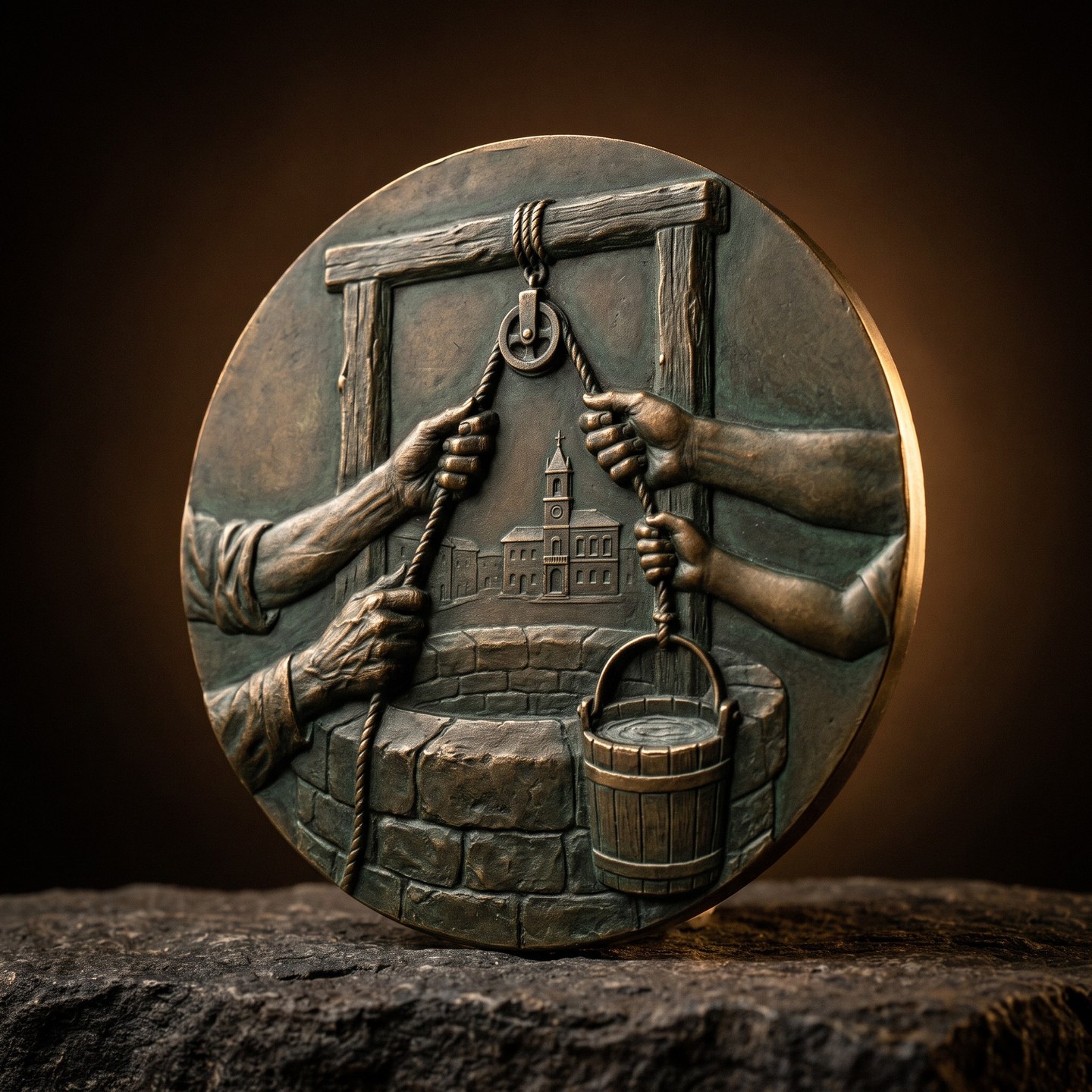
“Those things, which ye have both learned, and received, and heard, and seen in me, do: and the God of peace shall be with you.”
Philippians 4:9 (KJV)
I. The Parable
In a certain town there stood a well from which everyone drew water. The rich and the poor drew from it, believers and unbelievers, people who agreed with one another and those who for years had been unable to sit at the same table.
On the wall of the town hall were inscribed the words: truth, justice, responsibility, solidarity. Children learned them at school. Adults invoked them at ceremonies. Everyone knew how a good person ought to act.
One morning, no water could be drawn from the well.
The young worker who had repaired the mechanism the day before came to the town council.
— I may have made a mistake in the fitting. It needs to be checked.
Before anyone had looked into the well, the townspeople began handing down verdicts. Some demanded that the boy be punished. Others defended him because he belonged to their circle. Soon everyone was arguing about guilt, while beneath the well the buckets still stood empty.
Then the old craftsman who had supervised the repair spoke.
— I approved this work. I did not check everything I should have. Let us go and see what happened.
Together they took the mechanism apart. They found a badly fastened part, a worn mounting, and earlier reports to which no one had responded. They established what needed repair, who was responsible for it, and how future work would be checked.
The craftsman stayed with the boy. He showed him how to correct the fitting. Then he himself stood before the townspeople and told them where he had failed.
Meanwhile, a woman who lived by the market square brought water from her own supply for her elderly neighbours. A merchant lent his cart. Two townsmen who had been at odds for years drove it together to the neighbouring village.
By evening the well was working again.
The boy asked the craftsman:
— Why did you confess in front of everyone? You could have left the blame with me.
— I was teaching you responsibility. You had to see that I am subject to it myself.
From that day on, the townspeople began to report faults earlier. The council set aside money for the upkeep of the well and for a person responsible for inspections. Mistakes still happened. Disputes still went on. Yet more and more often someone set aside their own point of view in order to help with the common work.
The words on the town hall wall began to be borne out in life.
II. Wells That Must Be Dug Again
The well in this parable is no accidental stage set. In the Torah it is one of the oldest places where people learn to live alongside one another — and one of the first places they quarrel over.
The Book of Genesis tells how Abimelech’s servants seized a well dug by Abraham’s men. The dispute did not end in violence but in an oath: the two men made a covenant, and the place was named Beersheba — “the well of the oath” (Gen 21:25–31). The first biblical story of a quarrel over water thus ends not with a verdict but with an agreement that allows both sides to go on drawing from it.
A generation later Isaac faces something harder than a quarrel. The Philistines had stopped up the wells dug in Abraham’s lifetime. Isaac, we read, “digged again the wells of water, which they had digged in the days of Abraham his father … and he called their names after the names by which his father had called them” (Gen 26:18). Then he digs further. The herdsmen of Gerar quarrel over the first new well; Isaac names it Esek — “contention”. They quarrel over the second; he names it Sitnah — “enmity”. He digs a third, and this time no one takes it from him. He names it Rehoboth, saying: “For now the LORD hath made room for us, and we shall be fruitful in the land” (Gen 26:22).
This passage holds two truths which the parable of the common well repeats in the language of a town.
The first concerns inheritance. The words on the town hall wall are the wells of the fathers. They do not dry up of their own accord — they are stopped up by everyday life, by convenience, and by the habit of repeating them without checking whether they still give water. Every generation must dig them out again with its own hands, without changing their names. Values handed down but never dug out again are only an inscription.
The second concerns proportion. Isaac did not build his identity on winning at Esek. He called the quarrel by its name, he called the enmity by its name — and he kept digging until he found a place with room enough for everyone. Rehoboth is not a reward for winning a dispute. It is the fruit of a readiness not to make the dispute the goal.
III. The Stone on the Mouth of the Well
The Torah returns to the well several more times, and each time it teaches something different.
When Jacob arrives in Haran, he sees a well covered by a great stone and shepherds who are waiting. He asks why they do not water their flocks. They answer: “We cannot, until all the flocks be gathered together, and till they roll the stone from the well’s mouth” (Gen 29:8). The water is within arm’s reach, yet everyone is waiting for everyone else. It is the oldest description of a phenomenon we know well from institutions: responsibility spread so widely that it rests on no one. In the parable, that stone was the earlier reports to which no one responded. Everyone had seen them. No one thought it was their turn.
At the well of Nahor, Rebekah gives water to a thirsty traveller and then adds: “I will draw water for thy camels also, until they have done drinking” (Gen 24:19). She does more than she was asked — and it is by this that she is recognised. This is the tradition of chesed, loving-kindness that does not wait to be summoned. In the parable it is carried by the woman by the market square, who shares her own supply with her elderly neighbours before anyone has established whose fault it was.
Moses, a fugitive in Midian, sits by a well and sees shepherds driving the priest’s daughters away from the water. “Moses stood up and helped them, and watered their flock” (Ex 2:17). Here the well is a place of justice — a test of whether the weaker one will get water when the stronger stands closer.
And finally, the song of the wilderness: “Spring up, O well; sing ye unto it: the princes digged the well, the nobles of the people digged it, by the direction of the lawgiver, with their staves” (Num 21:17–18). The well is not dug by hirelings or by the weakest. It is dug by those who lead — with their own staves, the signs of their authority. The old craftsman of the parable is exactly this image: leadership that takes the tool in hand and goes down to the mechanism before it begins to speak.
IV. Broken Cisterns and the Word “Do”
Jeremiah recorded a charge that applies to every community that professes values: “They have forsaken me the fountain of living waters, and hewed them out cisterns, broken cisterns, that can hold no water” (Jer 2:13). A cistern looks like a well. It has a stone rim, an inscription and a place for ceremonies. But it holds no water. This is what a culture looks like when its values are written on the town hall wall, and in the hour of trial everyone argues about guilt while the buckets stand empty.
Jewish tradition answers this problem with a sentence that for two thousand years has ordered the relationship between knowledge and deed. In Pirkei Avot, Shimon son of Rabban Gamliel says: “Not study is the essential thing, but the deed” (Avot 1:17). He does not belittle learning — he was himself one of its guardians. He points to its measure: learning that does not pass into action is a cistern.
Christian tradition says the same in the words of James: “Be ye doers of the word, and not hearers only” (Jas 1:22), and: “Faith, if it hath not works, is dead” (Jas 2:17). And in the words of Paul with which we began. Paul does not write “remember” or “proclaim”. He writes “do” — and he points to himself as the example, thereby submitting to the same measure he applies to others. Only then does he promise peace.
Here the Torah and the Gospel speak with one voice, because they grow from one source. Knowledge of the good obliges. Especially when we hold power, experience or influence over another person’s life. A child watches how a parent treats the weaker. An employee sees whether a superior accepts responsibility. A patient learns the meaning of dignity at the moment they need help.
At Jacob’s well in Sychar, Jesus, wearied by the journey, asks a Samaritan woman: “Give me to drink” (John 4:7). She answers with astonishment, and the Evangelist adds: “for the Jews have no dealings with the Samaritans” (John 4:9). A conversation that changes her life begins with a request for water addressed across a border of enmity. The two quarrelling townsmen of the parable, who drive the cart together to the neighbouring village, did not have to be reconciled in order to begin. It was enough that both were thirsty for the same water and both saw that someone was waiting for it.
V. Hagar and the Well in the Wilderness
There is a third tradition that preserves the memory of the well as a place of rescue — and that shares the same heroine with the Torah.
The Book of Genesis tells of Hagar, cast out into the wilderness of Beersheba with her son Ishmael. When the water in the skin is spent, Hagar goes off about a bowshot away so as not to watch the child die. Then “God opened her eyes, and she saw a well of water” (Gen 21:19). Earlier, during her first flight, a well received the name Beer-lahai-roi — “the well of the Living One who sees me” (Gen 16:14). A woman from the margins of Abraham’s household is the first person in the Bible to give God a name — and she gives it by a well.
Islamic tradition preserves the same figure as Hajar, mother of Isma’il. A report recorded by al-Bukhari on the authority of Ibn Abbas tells how she ran between the hills of as-Safa and al-Marwa in search of water for her child, until the spring of Zamzam burst forth beside him (Sahih al-Bukhari 3364). Pilgrims to this day re-enact her running in the rite of sa’y. The memory of a mother searching for water for her child has become part of that tradition’s most important ritual.
The same tradition hands down a parable worth setting beside ours. A man walking along a road became thirsty, went down into a well and drank. When he came out, he saw a dog licking the damp earth out of thirst. So he went down again, filled his shoe with water and gave the animal to drink. For this deed — the report says — God thanked him and forgave him. Asked whether there is a reward even for kindness to animals, the Prophet answers that there is a reward for good done to every living being (Sahih al-Bukhari 2363). The Qur’an, for its part, recalls that “We made from water every living thing” (Qur’an 21:30).
Three cultures grown from the heritage of Abraham see the same thing at the well: water that does not belong to the winner of a dispute, but to whoever is thirsty. They do not thereby erase the differences between them, nor should they. But they point to a common measure: whether the person who came with an empty bucket left with a full one.
VI. Three Cultures under the One Sky of the Commonwealth
This is not merely a reflection on texts. Europe — and Poland in particular — has a historical experience of the common well.
In 1264 Duke Bolesław the Pious issued at Kalisz a statute guaranteeing legal protection to Jews, which successive rulers of Poland later confirmed and extended. From the fourteenth century, Tatars — Muslims who shed their blood in the service of the Commonwealth — settled in the lands of the Grand Duchy of Lithuania; their wooden mosques at Kruszyniany and Bohoniki still stand in Podlasie today. In 1573 the Warsaw Confederation recorded a commitment to keep the peace among those who differed in faith — at a time when much of Europe settled such differences by fire. On the Iberian Peninsula, in the twelfth and thirteenth centuries, the Toledo School of Translators passed knowledge on to Europe through the cooperation of Jewish, Christian and Muslim scholars.
Honesty requires adding: none of these experiences was an idyll. They contained tensions, injustices and periods of violence that must neither be passed over nor embellished. But it is precisely this that makes them credible. They show that the common well did not require unanimity. It required rules that everyone recognised, and people who made sure the water flowed even while a dispute went on. When the rules weakened and the well ceased to be treated as common, it ended in tragedy for everyone — as the twentieth century demonstrated with merciless precision.
VII. Just Culture at the Well
The parable also describes a mechanism which, in the language of safety management, we call Just Culture.
Notice the order of events. The young worker himself reports that he may have made a mistake. The community responds with a quarrel over guilt rather than an inspection of the mechanism — and the well stands idle for as long as the quarrel lasts. Only when someone proposes “let us go and see what happened” does it emerge that the fitting error was merely the last link: beside it lay a worn mounting and earlier reports left unanswered. Safety researchers have described accidents in exactly this way for decades — as the meeting of a final error with earlier, latent weaknesses in the system. Whoever stops at the last link will punish a person and leave the cause in place.
Just Culture helps us honestly recognise an error and its causes, learn, and repair the harm. It is not, however, a culture of impunity. It requires discernment between human error, at-risk behaviour whose risk the person did not perceive, and conscious disregard of danger. Error calls for support and a better system. A risky habit calls for correction and learning. Deliberate harm and disregard of danger must meet with proportionate consequences. Compassion that abolishes responsibility ceases to be compassion; justice that does not listen ceases to be justice.
Yet the most demanding gesture in the parable is not the analysis of the mechanism. It is the old craftsman’s sentence: “I approved this work.” The superior does not hide behind his subordinate, though he could. Nor does he take all the blame upon himself to close the matter — that would be a falsehood in the other direction. He states precisely where he himself failed, stays with the boy and teaches him the correct fitting. In the spirit of Just Council, example begins with a readiness to apply to ourselves the same principles we expect of others. Without it, every declaration of responsibility is a cistern.
The craftsman’s answer — “you had to see that I am subject to it myself” — is a commentary on Paul’s words: “heard, and seen in me”. Responsibility cannot be taught by lecture. It can be taught only by someone having seen it.
VIII. The Well as a Common Good
The ending of the parable is the least spectacular and the most important. The townspeople began to report faults earlier. The council set aside money for the upkeep of the well and for a person responsible for inspections. This is the moment when a single act of decency becomes an institution — when goodness ceases to depend on whether someone brave happens to be present.
Our common well is society: the hospital, the school, the public office, the workplace and the home. Every day someone comes to it with an empty bucket — with illness, fear, ignorance, or a matter they cannot resolve alone. A public well needs the same as the one in the parable: someone responsible for inspections; resources for upkeep before it breaks down; and a culture in which reporting a fault is an act of loyalty to the community, not an informing on oneself.
The parable does not promise a world without errors. “Mistakes still happened. Disputes still went on.” That sentence is an expression of humility, not resignation. Pirkei Avot captures the same attitude in the words of Rabbi Tarfon: “It is not your duty to finish the work, but neither are you free to desist from it” (Avot 2:16). A well is not repaired once and for all. It is dug out again in every generation, as Isaac dug out the wells of his father.
IX. The Measure
When I read St Paul’s call, I stop at the word: “do”.
A community does not know its values by what it has written on the town hall wall. It knows them by what it does in the morning when the well stops giving water: whether it first looks into the mechanism or first chooses someone to blame; whether the superior stands beside the younger one or behind him; whether someone brings water from their own supply before the dispute has ended.
Peace is built in this encounter too. In a word kept. In an honest admission of error. In help given to a person with whom we disagree.
Abraham and Abimelech turned a quarrel over a well into an oath. Isaac turned Esek and Sitnah into Rehoboth. Hagar, by the well, heard that she was seen. Each of these stories ends the same way: with water from which even those who quarrelled may drink.
May the person who has met us on their path be able to say: I have seen these values become deeds.
A parable from the Just Council series: on values that become deeds.
Sources: Philippians 4:9 (King James Version). Genesis 16:14; 21:19; 21:25–31; 24:19; 26:18–22; 29:8; Exodus 2:17; Numbers 21:17–18; Jeremiah 2:13; John 4:7–9; James 1:22; 2:17 (King James Version). Mishnah, tractate Avot 1:17 and 2:16. Sahih al-Bukhari 2363 and 3364. Qur’an 21:30. Statute of Kalisz (1264); Act of the Warsaw Confederation (28 January 1573).


Leave a Reply